Physical Communication for Safety and Trust
A movement method from Japan
for maintaining safety without harming others.
Protecting safety, dignity, and trust through physical communication.
What is Godo?
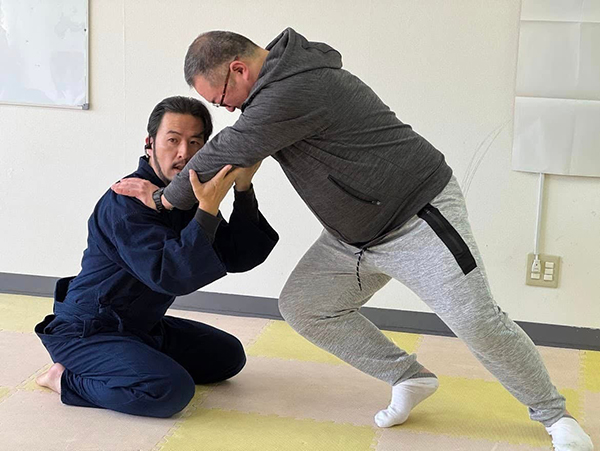
Godo is a movement method developed in Japan.
It teaches how to maintain safety during physical interaction without harming the other person or yourself.
Rather than relying on strength or force, Godo uses body mechanics, balance, and natural movement to guide situations safely.
The purpose of Godo is not to control people, but to respond to difficult situations in ways that protect safety, dignity, and trust.
Godo can also be understood as a form of physical communication, a way of interacting with others through the body while maintaining respect and human dignity.
How Godo Is Different
Many martial arts focus on winning fights, controlling an opponent, or defeating an attacker.
Godo takes a different approach.
The goal of Godo is not victory over another person, but mutual safety.
Instead of overpowering someone, Godo seeks to guide situations in ways that prevent harm to both people.
Another difference is that Godo is designed not only for martial arts practitioners but also for people working in caregiving, education, and support environments.
Because of this, the techniques emphasize calm interaction, safety, and the preservation of human dignity.
In this sense, Godo can be understood not only as a physical method but also as a way of communicating through the body.
Principles of Godo
Godo is based on several fundamental principles.
Non-Harm
The techniques of Godo are designed to avoid causing injury.
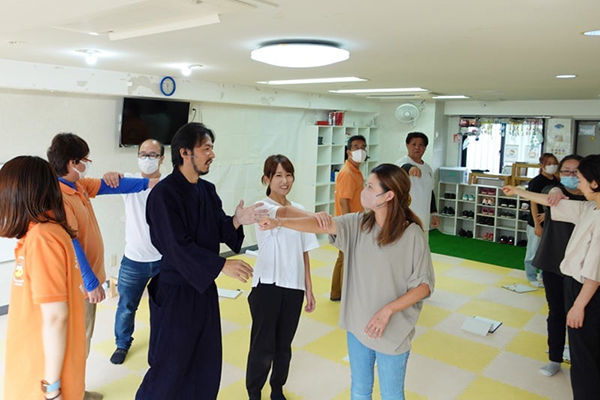
When physical contact becomes necessary, the goal is to guide the situation safely rather than overpower the other person.
Non-Confrontation
Godo does not rely on force against force.
Instead of resisting movements directly, it uses balance, positioning, and timing to redirect the situation.
This approach helps prevent escalation./
Dignity and Trust
In caregiving and support environments, physical responses can strongly affect human relationships.Godo emphasizes protecting the dignity of the person being supported and maintaining trust between people.
Fields of Application
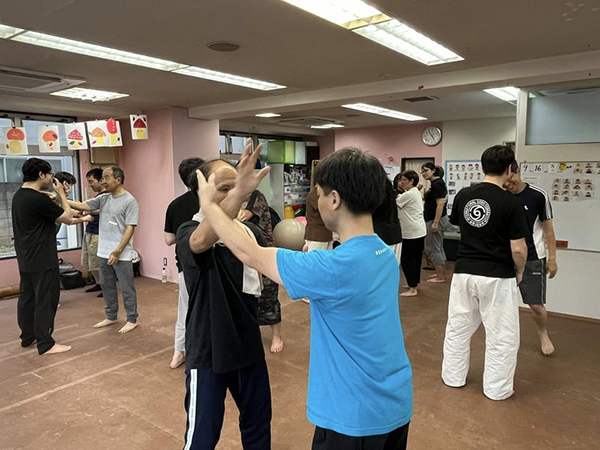
Godo is practiced in environments where safety and human interaction are important.
Examples include:
• Caregiving and welfare services
• Education and schools
• Disability support
• Medical environments
• Safety training for support professionals
In these fields, Godo is used as a method for maintaining safety while respecting the dignity of the person being supported.
Books
Publications explaining the philosophy and techniques of Godo.
Resources
You can learn more about Godo through the following materials
DVDs
Instructional videos demonstrating practical techniques
Videos
Online videos and demonstrations introducing the principles and applications of Godo.
Founder of Godo

Hiroki Doshin
Headmaster, International Godo Federation
Hiroki Doshin was born in January 1972 in Japan.From a young age he became interested in Bushido and martial arts after learning that his family lineage traces back to samurai of the Nabeshima domain in Saga.
He began martial arts training at the age of fifteen and studied Shorinji Kempo at seventeen. At nineteen he began training in karate and later received a black belt from the renowned karate master Hideyuki Ashihara.
He continued studying many Japanese martial arts including jujutsu, kenpo, and iaido, achieving the rank of sixth dan in iaido and serving as head instructor at his dojo.
He also researched international martial arts and combat sports including Chinese martial arts, boxing, Muay Thai, Savate, and Brazilian Jiu-Jitsu.
In addition to his martial arts career, Hiroki is the father of a son with an intellectual disability. Through his experience raising his child, he developed ways to guide panic situations safely without harming either person.
This experience eventually led to the development of the concept of Mutual Protection, which later became the foundation of Godo.
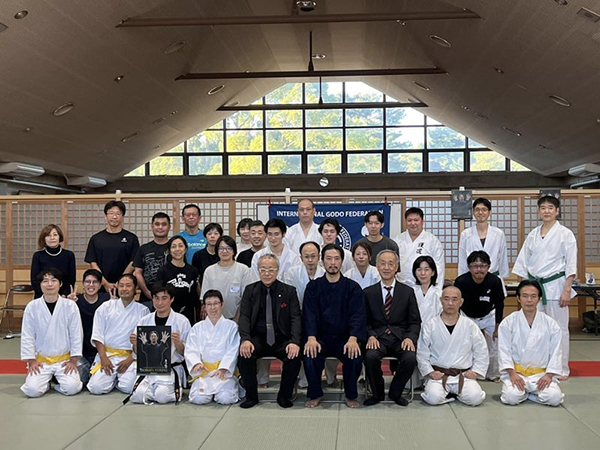
Hiroki later established the International Godo Federation and continues to work toward spreading the principles of Godo in caregiving, education, and support environments.
In 2022 the organization was incorporated as the General Incorporated Association Godo.
Works
自他護身武道「護道の心髄」-シンプルな術理で無限に応用! 出版社:BABジャパン https://www.amazon.co.jp/dp/4814206364
「護道の完成」-自他を護る実戦武道-路上の戦いから神武不殺の極意へ 出版社:BABジャパン https://www.amazon.co.jp/dp/4814204140/
「廣木道心先生の支援介助法」武術の技を活かした、お互いに傷つけないパニック対処法 出版社:BABジャパン https://www.amazon.co.jp/dp/B09VP3FQF5
「護道・廣木道心-武の達人」- 出版社:BABジャパン https://www.amazon.co.jp/dp/4814204183/
「廣木道心GODO護道」 出版社:クエスト
https://www.amazon.co.jp/dp/4863083238/
「発達障害・脱支援道」-笑顔と自由に満ちた未来のためにできること 出版社:花風社 https://www.amazon.co.jp/dp/4909100156/
「自傷・他害・パニックは防げますか?」-二人称のアプローチで解決しよう 出版社:花風社 https://www.amazon.co.jp/dp/B097XLFHP6/
発達障がいのある子どもへの支援介助法―子どもに痛みを与えないパニック対処スキル 出版社:ナカニシヤ出版 https://www.amazon.co.jp/dp/4779508908/
児童期・思春期のSST-特別支援教育編 出版社:三恵社 https://www.amazon.co.jp/dp/4864870411/
「Story-つよきもののふのうた-廣木道心編」 出版社:パンローリング https://www.amazon.co.jp//dp/4775922874/
「崩撃の術理~総合武道・躰全道」 出版社:壮神社 https://www.amazon.co.jp/dp/4915906949/
DVD
「支援介助法~痛みを与えないパニック対応スキル基本編」 出版社:アローウィン https://www.ryoikushop.jp/bin/showprod?c=2070000300002
「支援介助法~痛みを与えないパニック対応スキル応用編」 出版社:アローウィン https://www.ryoikushop.jp/bin/showprod?c=2070000400009
「教室の『あの子』を考えるシンポジウムグレーゾーンの子どもたちを読み解く」 出版社:Kaya出版 http://sogogakushu.gr.jp/kayaDVD/main.htm